When people discuss acoustic comfort, they often focus on reducing noise. But in reality, interior acoustic design is much more than that. It’s a system that combines physics, materials, and architecture to create spaces that sound as good as they look. From meeting rooms to recording studios, how we control sound determines how comfortable and efficient a space can be.
So, what’s really behind it? Two key concepts: sound absorption and sound insulation. They sound similar, but they solve very different problems.
1. Sound Absorption vs. Sound Insulation — The Basic Difference
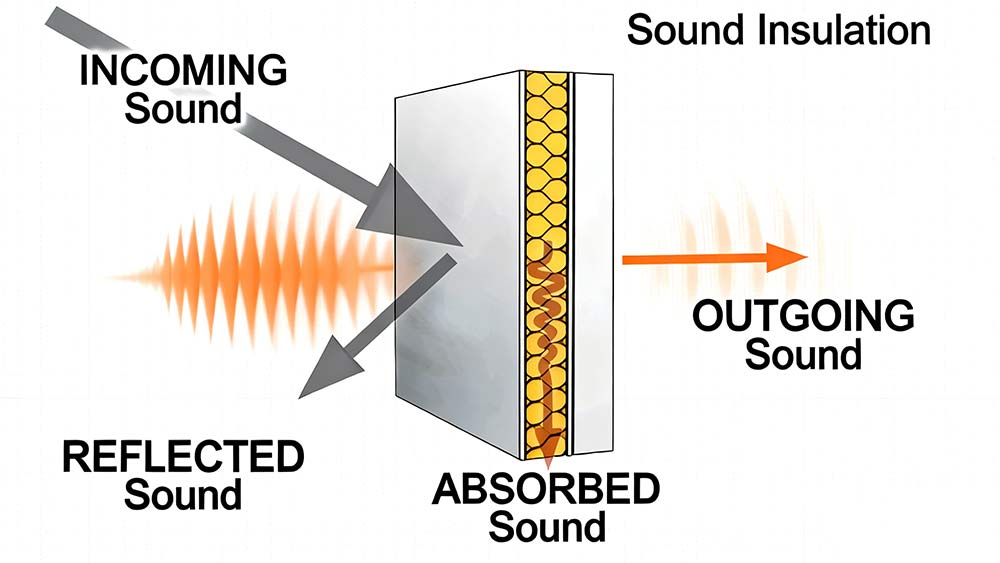
When sound hits a wall or any surface, part of it is reflected, part of it is absorbed, and some of it passes through.
Sound absorption focuses on reducing reflected sound. It keeps the room from sounding “echoey” or harsh.
Sound insulation aims to stop sound from traveling from one room to another — like keeping office noise out of a conference room.
Both are essential in modern acoustic design, but they work on opposite sides of the problem.
2. How They Work
| Category | Sound Absorption | Sound Insulation |
| Main Goal | Reduce echo and reverberation | Block sound transmission |
| How It Works | Converts sound energy into heat inside porous materials | Uses dense, airtight structures to block sound |
| Common Materials | Fiberglass, rock wool, PET felt, foam | Concrete, gypsum board, steel, dense panels |
| Performance | NRC (Noise Reduction Coefficient) | STC (Sound Transmission Class) |
In short:
Absorption improves what you hear inside.
Insulation controls what you don’t want to hear from outside.
3. Materials That Absorb Sound
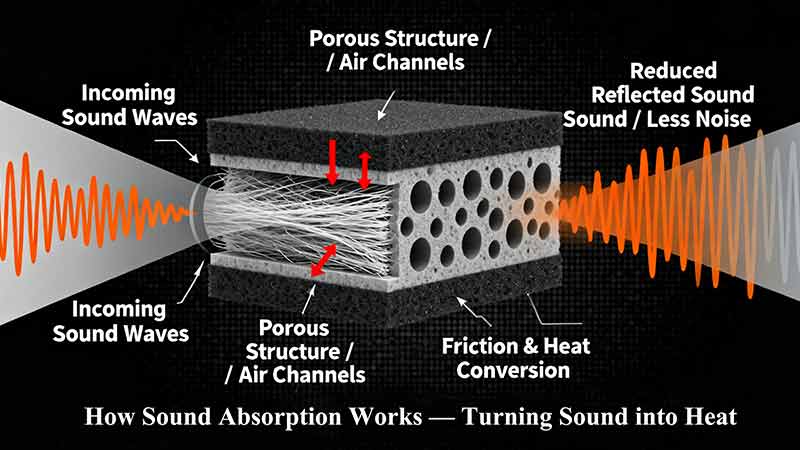
Sound-absorbing materials are full of tiny air channels. When sound waves enter, air molecules rub against the fiber or pore walls, turning energy into heat — that’s how noise is reduced.
Typical options include:
Glass wool acoustic panels — lightweight, high NRC, and fire-safe.
Rock wool panels — denser, offering both sound absorption and some insulation.
Fabric-covered panels — decorative and effective for offices and auditoriums.
Recycled PET panels — eco-friendly, made from plastic bottles.
Flat panels usually don’t perform well at low frequencies.
To improve that, some designs use perforated or wedge-shaped surfaces, helping capture deeper sounds.
4. Resonant Absorption — Targeting Low Frequencies
Low-frequency sound is the hardest to control. That’s where resonant absorbers come in. These systems are designed to target specific frequency ranges, like bass noise.
Common examples include:
Thin film or membrane absorbers
Panel and perforated board resonators
Helmholtz resonators
They are often used in recording studios, theaters, or technical spaces that demand high acoustic precision.
5. How Sound Insulation Works
Unlike absorption, sound insulation is all about mass and airtightness. The heavier and more solid the wall, the better it blocks sound.
However, increasing wall thickness alone is not always effective or practical. That’s why modern designs often use double-layer structures.
Double Walls for Better Soundproofing
The two layers should not be connected rigidly — vibrations can transfer through solid links.
Instead, elastic connectors or air gaps are used to create a “floating” structure.
Every joint and opening must be sealed — because if air leaks, sound leaks.
According to the Mass Law, doubling a wall’s mass increases sound insulation by roughly 6 dB. So rather than just building thicker walls, designers combine density + separation + sealing to get the best results.
6. Using Both Together
In real projects, you never rely on only one approach.
A good acoustic design uses both:
Sound absorption to improve clarity and comfort inside the space.
Sound insulation to protect privacy and block outside noise.
For example, an office might use fabric acoustic panels on the walls to reduce echoes, while the meeting room walls are built with sound-insulating rock wool to keep conversations private.
The result is a quieter, more professional, and more pleasant environment.
7. Final Thoughts
Sound absorption and sound insulation are not competitors — they’re partners. Each plays a unique role in shaping how a space feels and sounds.
For professionals in architecture, construction, or the acoustic materials industry, understanding both concepts is key to delivering projects that meet real-world acoustic needs.
About IKING — Data-Driven Manufacturing for Better Insulation
For more than 19 years, IKING has been focusing on the manufacturing of insulation and acoustic materials, including glass wool, rock wool, and related systems.
99.7% on-time delivery rate
<0.3% defect rate
100% traceability for every batch
[ Read More >>]


